
Introduction
Mechanisms of gut and immune support
Clinical evidence
Forms and dosage
Safety notes
References
Further reading
How an ancient Mediterranean resin is reshaping modern understanding of gut lining resilience, immune signaling, and microbiota-driven inflammation.
Image Credit: rawf8 / Shutterstock.com
Introduction
Mastiha is a natural resin obtained from the stems and branches of the Pistacia lentiscus tree, particularly the Chios variety. Mastiha has been used throughout the Mediterranean region for over 2,500 years, with historical records from Hippocrates, Dioscorides, and Galen describing its use in managing gastrointestinal complaints such as dyspepsia, gastralgia, and peptic ulcers.
Mastiha is rich in phenolic compounds, phytosterols, and arabinogalactan proteins, with approximately 30% of its composition consisting of the natural polymer poly-β-myrcene. Among these compounds, terpenes are particularly abundant, with monoterpenes like α-pinene, β-pinene, and β-myrcene, as well as triterpenes including mastihadienonic and isomastihadienonic acids.1,2
Rather than acting as a classical fermentable prebiotic fiber, mastiha appears to exert microbiota-modulating effects through selective antimicrobial activity and host–microbe immune signaling, indirectly supporting microbial diversity and gut homeostasis.3,4
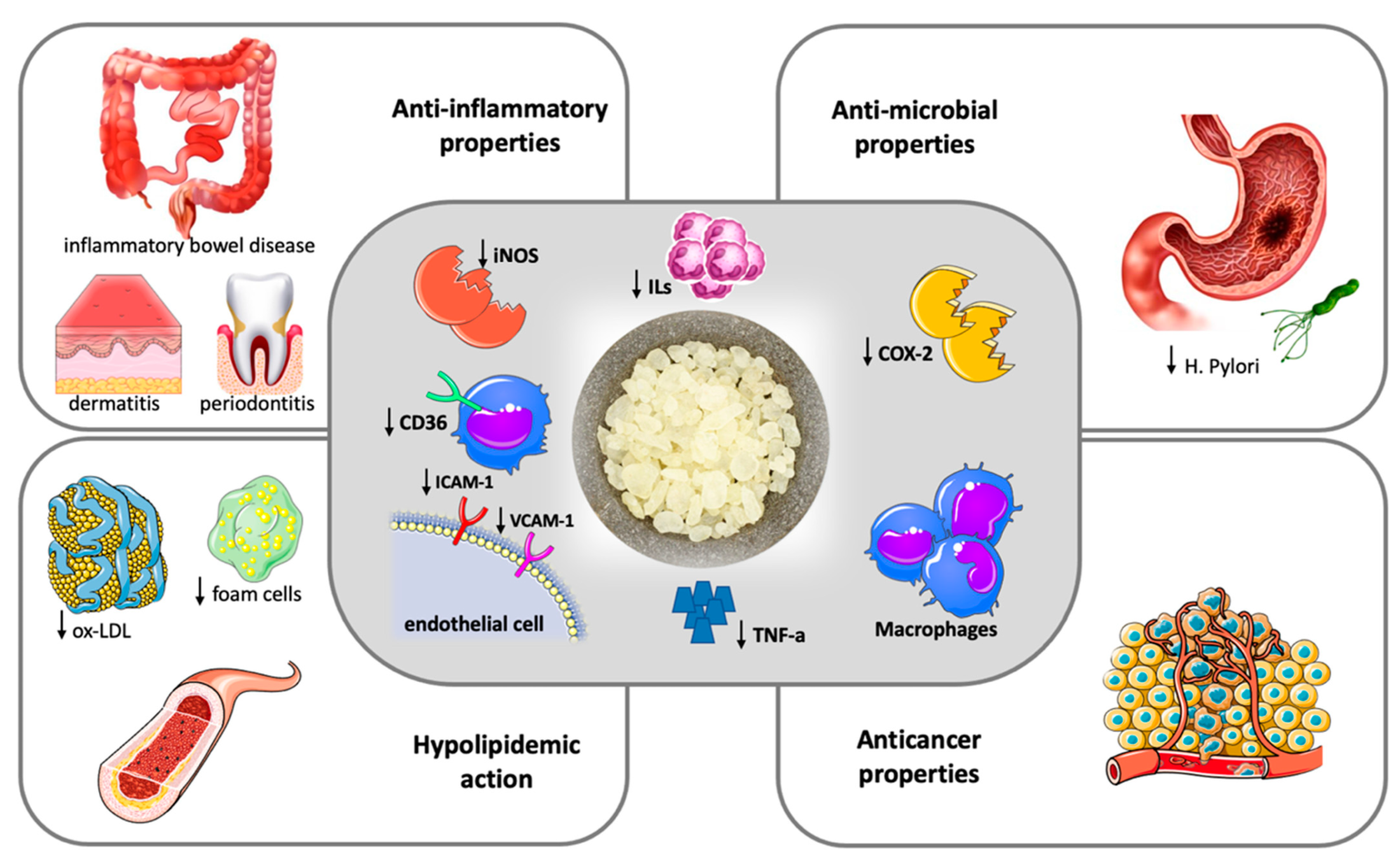
Therapeutic potentials of Chios Mastic.4
Mechanisms of gut and immune support
Preclinical and clinical evidence indicate that mastiha modulates gut microbial composition rather than directly stimulating bacterial proliferation. In a murine non-alcoholic steatohepatitis (NASH) model, mastiha supplementation improved hepatic steatosis and fibrosis while enhancing gut microbiota diversity. In human NAFLD trials, mastiha supplementation altered beta-diversity, downregulated pro-inflammatory taxa such as Flavonifractor, and reduced bile acid–related and phospholipid metabolites, suggesting indirect microbiota remodeling.3,4
Mastiha enhances mucosal barrier integrity and reduces gut permeability. In dextran sodium sulfate (DSS)-induced colitis, oral mastiha protects against colon injury and attenuates expression of pro-inflammatory cytokines, including TNF-α and IL-6, alongside adhesion molecules such as ICAM-1.7,8
Mechanistic studies demonstrate that mastiha triterpenes activate antioxidant defense pathways (including Nrf2-mediated glutathione synthesis) while suppressing NF-κB and MAPK signaling cascades. In Sprague-Dawley rats with colitis, oral mastiha resin oil at 400 mg/kg/day decreased the total colitis index, while intrarectal administration significantly reduced TNF-α, with efficacy comparable to that of prednisolone. Across experimental colitis models, mastiha consistently downregulates TNF-α and IL-6, supporting its role as an immunomodulatory adjunct rather than a direct immunosuppressant.5–8
Mastiha exhibits notable antimicrobial activity against Helicobacter pylori. Clinical trials demonstrate partial eradication rates and significant reductions in bacterial load, rather than complete eradication. Broad antibacterial and antifungal activity against Staphylococcus, Streptococcus, and Candida species further supports its adjunctive role in digestive and oral immune health.4,9
Clinical evidence
In a randomized controlled trial of adults with functional dyspepsia, 350 mg of mastiha resin three times daily for 21 days significantly improved epigastric pain and dyspeptic symptoms compared with placebo. These benefits are attributed to local antioxidant and anti-inflammatory effects on the gastric mucosa rather than acid suppression.1,10
Although direct IBS-specific trials are limited, extrapolation from IBD studies suggests benefit in symptoms driven by low-grade inflammation and barrier dysfunction. In a double-blind trial of 60 patients with IBD, 2.8 g/day of mastiha for three months improved IBDQ quality-of-life scores, reduced fecal lysozyme, and lowered oxidative stress biomarkers, without inducing clinical immunosuppression.8,10,11
Smaller clinical studies report that four-week supplementation with 2.2 g/day in patients with active Crohn’s disease reduced CRP, IL-6, and TNF-α levels. Symptom improvement occurred in a subset of participants and should be interpreted cautiously due to the limited sample size.12–15
In quiescent IBD, six-month supplementation prevented increases in plasma free amino acids, an early metabolic marker of mucosal stress, without altering remission rates. Additional mechanistic studies demonstrate modulation of miRNA-155–Th17 signaling, preservation of tight junction proteins such as ZO-1, and shifts in fecal metabolites linked to epithelial resilience rather than direct disease remission.10–15
Forms and dosage
Mastiha is available in several forms used across clinical and traditional settings. Chewing gum or whole resin pieces represent the oldest mode of intake. Powdered mastiha and encapsulated resin are most commonly used in clinical trials for dosing consistency.4,16
Clinically studied doses range from ~1 g/day for dyspepsia and H. pylori adjunct therapy to 2.2–2.8 g/day in IBD trials. Higher intakes (≥4 g/day) appear primarily in older or exploratory studies and are not routinely recommended. Trial durations typically range from 2 to 12 weeks, with more extended observational use requiring medical supervision.3,4
Safety notes
Clinical trials consistently report that mastiha is well-tolerated, with adverse events comparable to those observed with placebo. Allergic reactions are rare but possible, particularly in individuals with known sensitivities to Pistacia or Anacardiaceae.
Animal toxicity findings occur at exposures far exceeding human supplemental doses. Long-term safety data in pregnancy, lactation, and pediatric populations remain insufficient; therefore, routine use is not recommended in these groups.4,16
References
- Davila, M. M., & Papada, E. (2023). The Role of Plant-Derived Natural Products in the Management of Inflammatory Bowel Disease – What Is the Clinical Evidence So Far? Life 13(8); 1703. DOI: 10.3390/life13081703. https://www.mdpi.com/2075-1729/13/8/1703.
- Ottria, R., Xynomilakis, O., Casati, S., et al. (2023). Chios Mastic Gum: Chemical Profile and Pharmacological Properties in Inflammatory Bowel Disease: From the Past to the Future. International Journal of Molecular Sciences 24(15). DOI: 10.3390/ijms241512038. https://www.mdpi.com/1422-0067/24/15/12038.
- Kannt, A., Papada, E., Kammermeier, C., et al. (2019). Mastiha (Pistacia lentiscus) Improves Gut Microbiota Diversity, Hepatic Steatosis, and Disease Activity in a Biopsy‐Confirmed Mouse Model of Advanced Non‐Alcoholic Steatohepatitis and Fibrosis. Molecular Nutrition & Food Research 63(24). DOI: 10.1002/mnfr.201900927. https://onlinelibrary.wiley.com/doi/10.1002/mnfr.201900927
- Soulaidopoulos, S., Tsiogka, A., Chrysohoou, C., et al. (2022). Overview of Chios Mastic Gum (Pistacia lentiscus) Effects on Human Health. Nutrients 14(3); 590. DOI: 10.3390/nu14030590. https://www.mdpi.com/2072-6643/14/3/590.
- Papada, E., & Kaliora, A. C. (2019). Antioxidant and Anti-Inflammatory Properties of Mastiha: A Review of Preclinical and Clinical Studies. Antioxidants 8(7); 208. DOI: 10.3390/antiox8070208. https://www.mdpi.com/2076-3921/8/7/208.
- Ostovan M., Fazljou S. M. B., Khazraei H., et al. (2020). The anti-inflammatory effect of Pistacia lentiscus in a rat model of colitis. Journal of Inflammation Research 13. DOI: 10.2147/JIR.S259035. https://www.dovepress.com/the-anti-inflammatory-effect-of-pistacia-lentiscus-in-a-rat-model-of-c-peer-reviewed-fulltext-article-JIR
- Boutemine I., Amri, M., Dorgham, K., et al. (2021). Beneficial role of Pistacia lentiscus aqueous extract in experimental colitis: Anti-inflammatory and potential therapeutic effects. Inflammopharmacology 29; 1225-1239. DOI: 10.1007/s10787-021-00831-w. https://link.springer.com/article/10.1007/s10787-021-00831-w.
- Cui H., Li X., An X., et al. (2023). Masticadienonic acid from Chios mastic gum mitigates colitis in mice via modulating inflammatory response, gut barrier integrity and microbiota. Phytomedicine 108. DOI: 10.1016/j.phymed.2022.154518. https://www.sciencedirect.com/science/article/abs/pii/S0944711322006067.
- Dabos, K. J., Sfika, E., Vlatta, L. J., & Giannikopoulos, G. (2010). The effect of mastic gum on Helicobacter pylori: a randomized pilot study. Phytomedicine 17(3-4); 296-299. DOI: 10.1016/j.phymed.2009.09.010. https://www.sciencedirect.com/science/article/abs/pii/S0944711309002396
- Papada, E., Amerikanou, C., Torovic, L., et al. (2019). Plasma free amino acid profile in quiescent Inflammatory Bowel Disease patients orally administered with Mastiha (Pistacia lentiscus); a randomised clinical trial. Phytomedicine 56; 40-47. DOI: 10.1016/j.phymed.2018.08.008. https://www.sciencedirect.com/science/article/abs/pii/S0944711318302733
- Amerikanou, C., Papada, E., Gioxari, A., et al. (2021). Mastiha has efficacy in immune-mediated inflammatory diseases through a microRNA-155 Th17 dependent action. Pharmacological Research 171. DOI: 10.1016/j.phrs.2021.105753. https://www.sciencedirect.com/science/article/abs/pii/S1043661821003376.
- Papada, E., Forbes, A., Amerikanou, C., et al. (2018). Antioxidative Efficacy of a Pistacia lentiscus Supplement and Its Effect on the Plasma Amino Acid Profile in Inflammatory Bowel Disease: A Randomised, Double-Blind, Placebo-Controlled Trial. Nutrients 10. DOI: 10.3390/nu10111779. https://www.mdpi.com/2072-6643/10/11/1779.
- Nakaya, M., Xiao, Y., Zhou, X., et al. (2014). Inflammatory T cell responses rely on amino acid transporter ASCT2 facilitation of glutamine uptake and mTORC1 kinase activation. Immunity 40; 692-705. DOI: 10.1016/j.immuni.2014.04.007. https://www.cell.com/immunity/fulltext/S1074-7613(14)00121-6.
- Amerikanou, C., Dimitropoulou, E., Gioxari, A., et al. (2021). Linking the IL-17A immune response with NMR-based faecal metabolic profile in IBD patients treated with Mastiha. Biomedical Pharmacotherapy 138. DOI: 10.1016/j.biopha.2021.111535. https://www.sciencedirect.com/science/article/pii/S0753332221003206.
- Naouar M. S., Mekki L. Z., Charfi L., et al. (2016). Preventive and curative effect of Pistacia lentiscus oil in experimental colitis. Biomedical Pharmacotherapy 83; 577-583. DOI: 10.1016/j.biopha.2016.07.021. https://www.sciencedirect.com/science/article/abs/pii/S0753332215304480.
- Alwadi, M., Sidhu, A., Khaled, M. B., & Aboul-Enein, B. H. (2023). Mastic (Pistacia lentiscus) gum and oral health: a state-of-the-art review of the literature. Journal of Natural Medicines 77; 430-445. DOI: 10.1007/s11418-023-01704-y. https://link.springer.com/article/10.1007/s11418-023-01704-y
Further Reading
Last Updated: Jan 4, 2026