
Introduction
Top ACN-rich foods
Mechanisms of action
Benefits for brain health
Cardiovascular effects
Skin health benefits
Optimal intake and safety
References
Further reading
Purple foods aren’t just pretty! Here’s what anthocyanins are actually doing inside your body, and why the best evidence points to specific heart and brain benefits (with skin protection emerging).
Image Credit: Yulia Furman / Shutterstock.com
Introduction
Anthocyanins (ACNs) are flavonoid pigments that are responsible for the red, blue, and purple hues of berries, grapes, cabbage, and other plant foods. ACNs appear red in acidic environments and shift toward blue at higher pH, with these tones blending together in plants that produce the deep purple shades characteristic of blueberries, black rice, and purple sweet potatoes.1
After ingestion, intact anthocyanins are generally detected at low concentrations in circulation, while a broader range of conjugated and microbially derived metabolites (e.g., methylated, sulfated, glucuronidated forms, and smaller phenolic acids) can persist longer and may contribute to biological effects.1,14
Top ACN-rich foods
ACN-rich foods comprise various functional pigments, known as anthocyanidins like cyanidin, delphinidin, pelargonidin, peonidin, petunidin, and malvidin. These pigments most often occur in foods as glycosides (“anthocyanins”), rather than as free aglycones (“anthocyanidins”). Berries are among the richest natural sources of ACNs, with levels reaching up to 611 mg/100 g. Blueberries, blackberries, blackcurrants, elderberries, and haskap berries provide particularly high amounts of key compounds such as cyanidin-3-O-glucoside (C3G) and delphinidin derivatives, making them reliable dietary sources of ACNs.1,15
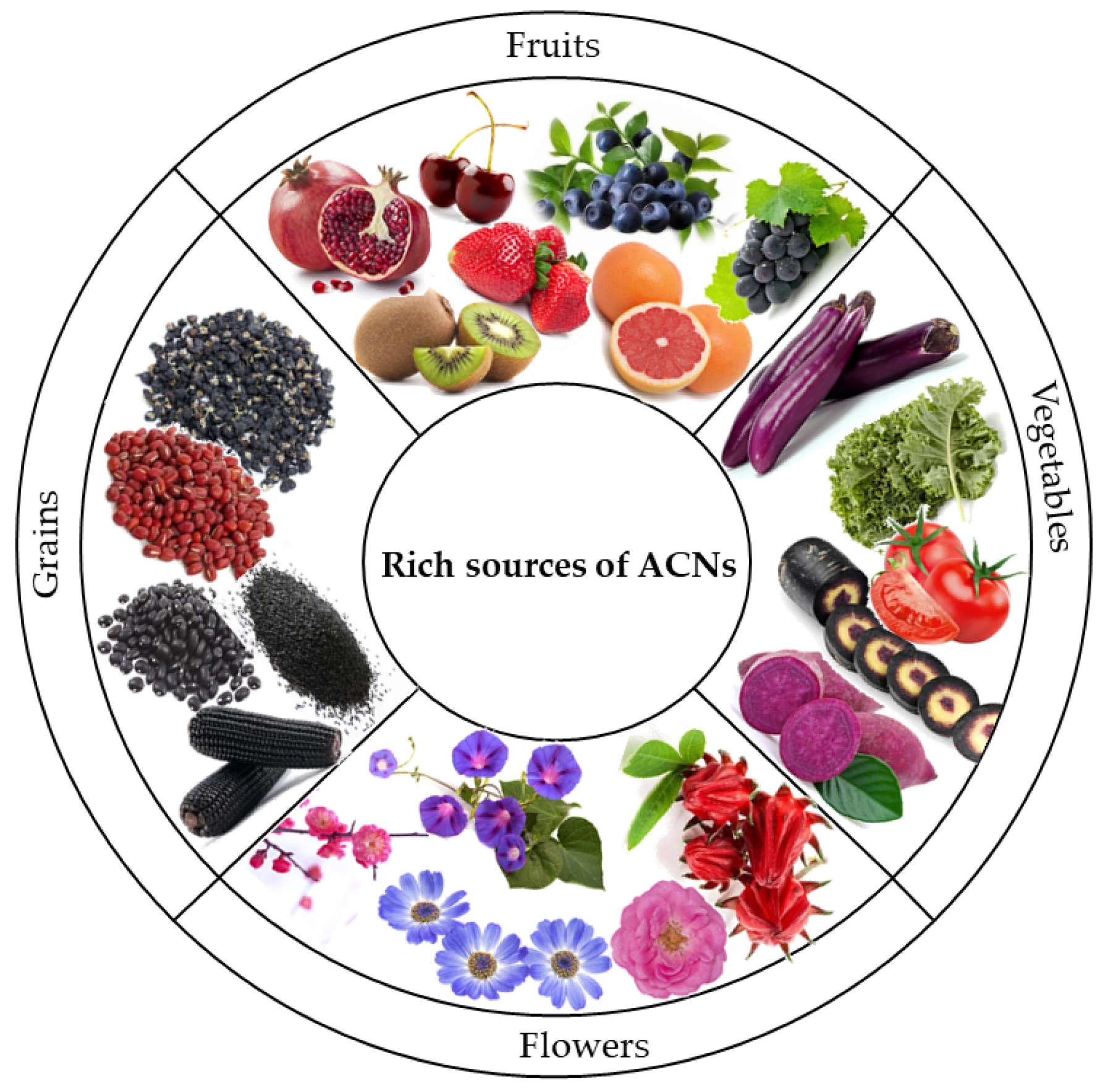
Sources of anthocyanins (ACNs).3
Purple grapes and their juices, as well as dark grape varieties used in red wine, contain high levels of malvidin glycosides, peonidin, and petunidin. Plums provide additional cyanidin-rich contributions, whereas eggplant skin contains nasunin, an acylated ACN that shows antioxidant and metal-chelating activity in experimental models.1,4
Among vegetables and grains, purple cabbage offers up to 75 mg/100 g, while purple sweet potatoes contain stable acylated ACNs dominated by cyanidin and peonidin forms. Pigmented staples like black rice and purple corn supply ACNs within nutrient-dense, fiber-rich staple foods.1,15
Mechanisms of action
ACNs function as antioxidants by neutralizing reactive oxygen species (ROS), binding metal ions, and activating the nuclear factor erythroid 2-related factor 2 (Nrf2) pathway. These actions stimulate major antioxidant enzymes, such as superoxide dismutase (SOD), catalase (CAT), and glutathione peroxidase (GPx), thereby reducing oxidative stress-related cellular damage.5
Mechanistic studies indicate that anthocyanins and/or their metabolites can be detected in brain tissue in experimental settings, and that anthocyanins have been reported to cross the blood–brain barrier, although the extent and physiological relevance in humans remain active research areas.1,5
In humans, some cardiometabolic and cognitive effects are often discussed in the context of vascular function and metabolite activity rather than in terms of high circulating levels of intact anthocyanins.5,14 Moreover, randomized trials report that the consumption of ACN-rich purple potatoes can lower markers of redox imbalance and inflammation in men.10
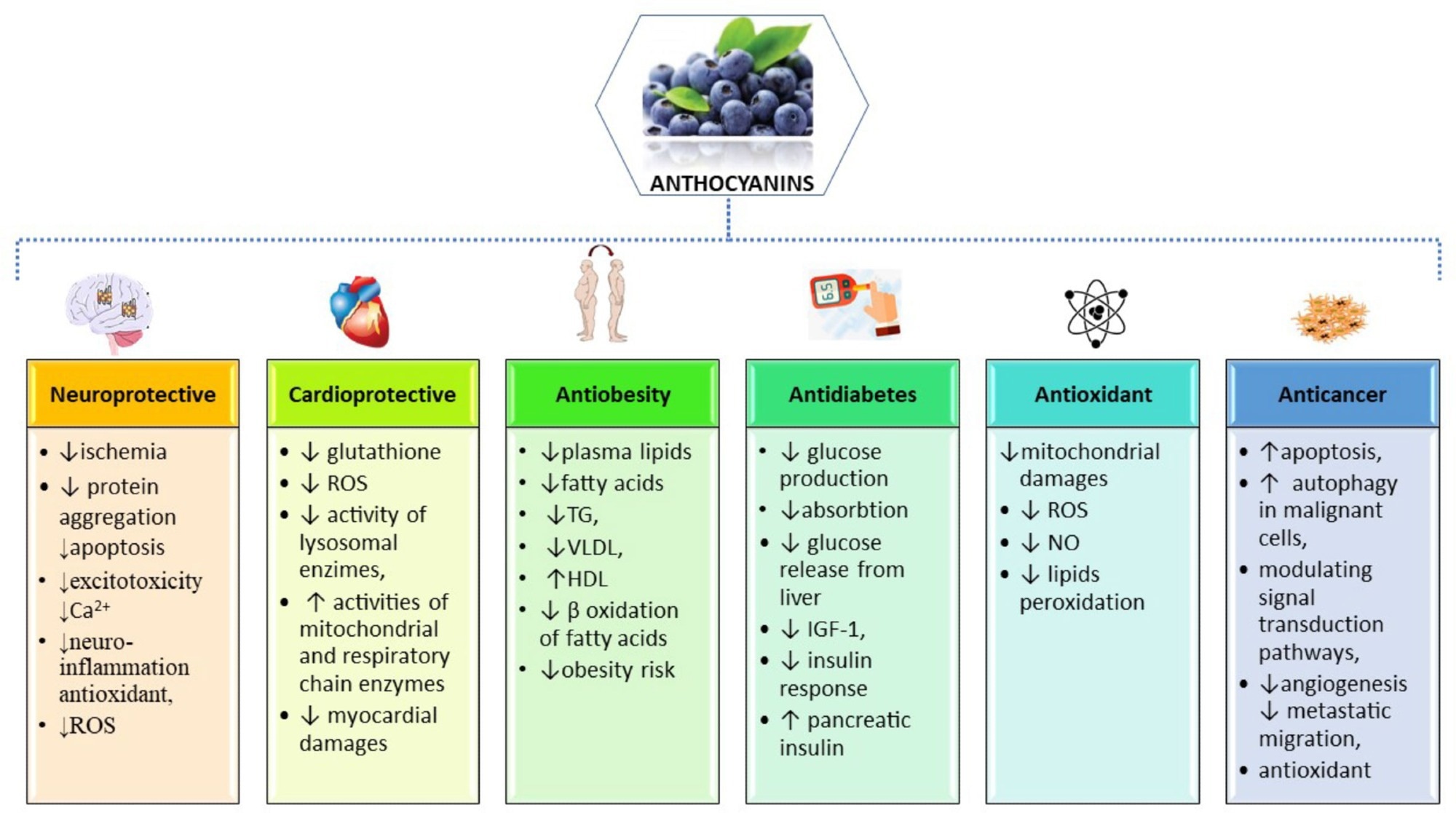
Summarized scheme of the most important pharmacological properties and molecular mechanisms of action of anthocyanins.5
ACNs support vascular function by improving nitric oxide (NO) bioavailability, enhancing antioxidant defense, as well as modulating phosphatidylinositol 3-kinase/protein kinase B (PI3K/Akt) and AMP-activated protein kinase (AMPK) signaling. These biological responses often correlate with improved vasodilation, blood-pressure modulation, and reduced platelet aggregation, all of which reduce the risk of atherosclerosis and ischemia-related damage.5
In the brain, ACNs suppress inflammatory signaling by inhibiting nuclear factor kappa B (NF-κB) and mitogen-activated protein kinase (MAPK) pathways. Consequently, ACNs inhibit inflammatory cytokines like tumor necrosis factor-alpha (TNF-α), interleukin-1 beta (IL-1β), and IL-6.5
ACNs also reduce cyclooxygenase-2 (COX-2) levels, thereby preventing microglial overactivation. Moreover, ACNs have been shown to preserve the extracellular matrix (ECM) by inhibiting matrix metalloproteinases (MMPs), thereby slowing collagen degradation to protect vascular and dermal tissue.5,15
By lowering ROS burden and strengthening endogenous antioxidant defenses, ACNs reduce low-density lipoprotein (LDL) oxidation, an early risk factor for atherosclerosis. This activity complements the effects of ACNs on endothelial function and inflammation that collectively contribute to their overall cardiovascular benefits.5,9
Image Credit: Avdeyukphoto / Shutterstock.com
Benefits for brain health
Aging remains the primary risk factor for neurodegenerative conditions like Alzheimer’s disease, Parkinson’s disease, and amyotrophic lateral sclerosis (ALS). Growing evidence suggests that ACNs may help support aspects of cognitive performance in older adults in some trials by enhancing memory performance, improving neural efficiency, and promoting overall brain function.6
Preclinical data often report effects on neurotrophic and inflammatory pathways, but translation to clinically meaningful outcomes in humans depends on population, dose, and intervention duration.5,6
In a 12-week randomized trial7, older adults with mild-to-moderate dementia who consumed 200 mL/day of cherry juice experienced significant improvements in language fluency and memory. Individuals with mild cognitive impairment (MCI) also showed stronger responses on working-memory tasks following blueberry supplementation, reflecting improved neural efficiency.8 Among healthy older adults, a 30 mL/day blueberry concentrate intervention for 12 weeks improved cerebral blood flow and enhanced activity in brain regions essential for memory and executive function.11
In healthy older adults, daily wild blueberry powder for 12 weeks improved endothelial function and was also associated with better performance on select memory and executive-function outcomes, although not all mechanistic endpoints (e.g., cerebral blood flow) changed.12
Cardiovascular effects
Human intervention studies have repeatedly shown that ACN intake improves blood pressure and arterial measures. In older adults, consuming freeze-dried wild blueberries for 12 weeks improved flow-mediated dilation and lowered 24-hour systolic blood pressure.12
Shorter-term studies also report selective benefits (often subtle) on blood pressure and/or vascular measures after berry extracts, but effects vary by dose, formulation, and endpoint.3,13
ACNs, particularly C3G, also contribute to healthier blood vessel function, a critical determinant of vascular health. Clinical studies routinely report improvements in vessel dilation that depend on the inner vascular lining.9,12
Experimental research supports these observations, with reports of reduced endothelial inflammation and enhanced cellular capacity to withstand stress in vivo. For example, ACN-rich Chinese cabbage extracts reduced plasma vascular cell adhesion molecule-1 (VCAM-1) and inflammatory cytokine levels, ultimately reducing plaque formation in hyperlipidemic mice.8
Meta-analytic and systematic review evidence suggests anthocyanin interventions can improve some cardiovascular risk markers (such as LDL cholesterol) in certain populations, though results can be heterogeneous across trials.1,9
Skin health benefits
ACNs protect the skin from ultraviolet light (UV)-induced damage by neutralizing ROS, reducing lipid oxidative degradation, supporting antioxidant systems such as glutathione (GSH), SOD, and CAT, and enhancing cellular stress tolerance. Most evidence for photoaging repair comes from cell and animal models, with more limited human clinical data.15
ACNs also inhibit inflammatory signaling in UV-exposed skin by downregulating MAPK, PI3K/Akt, and NF-κB pathways. Across experimental models, anthocyanins have been reported to reduce oxidative stress, dampen inflammatory signaling, support collagen synthesis, and inhibit pigmentation-related pathways relevant to photoaging.15,5
ACNs support ECM integrity by synthesizing type I collagen and inhibiting MMP-mediated collagen degradation. Extracts from black rice, blackcurrant, and purple sweet potato support procollagen expression and reduce UV-induced MMP activity in experimental systems. Through antioxidant, anti-inflammatory, and anti-MMP actions, ACNs may help maintain dermal elasticity and protect against photoaging.15
Optimal intake and safety
Direct “head-to-head” comparisons of anthocyanin bioavailability and health effects from whole foods versus isolated extracts remain relatively scarce; however, the available literature often favors whole-food intake, in part due to “food matrix” effects and nutrient synergy.14
In vitro digestion and transport studies illustrate that stability and apparent recovery of anthocyanins can vary widely by source, structure (e.g., acylated vs non-acylated), and matrix conditions, sometimes exceeding 100% “recovery” at certain stages due to release from the food matrix and analytical factors.14
Many human trials delivering measurable vascular or cognitive endpoints use anthocyanin doses in the hundreds of milligrams per day (e.g., ~302 mg/day in a 12-week wild-blueberry trial), but optimal dosing likely differs by health outcome and population.12
Most clinical studies assessing cardiovascular, cognitive, metabolic, or anti-inflammatory outcomes use daily ACN intakes ranging from tens of milligrams to several hundred milligrams, depending on the food or extract used. Regulatory assessments by the Food and Agriculture Organization (FAO), World Health Organization (WHO), and European Food Safety Authority (EFSA) have not identified safety concerns at customary intake levels.1
The Joint FAO/WHO Expert Committee on Food Additives has set an acceptable daily intake of 2.5 mg/kg/day for grape-skin-derived ACNs, whereas China has proposed a reference intake of 50 mg/day. Taken together, existing evidence strongly indicates that ACN-rich whole foods are a physiologically appropriate way to increase intake while offering measurable biological activity within a generally recognized safe intake range.1
References
- Winter, A. N., & Bickford, P. C. (2019). Anthocyanins and Their Metabolites as Therapeutic Agents for Neurodegenerative Disease. Antioxidants 8(9), 333. DOI: 10.3390/antiox8090333. https://www.mdpi.com/2076-3921/8/9/333.
- Wallace, T. C., & Giusti, M. M. (2015). Anthocyanins. Advances in Nutrition 6(5); 620-2. DOI: 10.3945/an.115.009233. https://www.sciencedirect.com/science/article/pii/S2161831323001072.
- Guo, X., He, L., Sun, J., et al. (2024). Exploring the Potential of Anthocyanins for Repairing Photoaged Skin: A Comprehensive Review. Foods 13(21): 3506. DOI: 10.3390/foods13213506. https://www.mdpi.com/2304-8158/13/21/3506.
- Kumkum, R., Aston-Mourney, K., McNeill, B. A., Hernández, D., & Rivera, L. R. (2024). Bioavailability of Anthocyanins: Whole Foods versus Extracts. Nutrients 16(10); 1403. DOI: 10.3390/nu16101403. https://www.mdpi.com/2072-6643/16/10/1403.
- Salehi, B., Sharifi-Rad, J., Cappellini, F., et al. (2020). The Therapeutic Potential of Anthocyanins: Current Approaches Based on Their Molecular Mechanism of Action. Frontiers in Pharmacology 11. DOI: 10.3389/fphar.2020.01300. https://www.frontiersin.org/journals/pharmacology/articles/10.3389/fphar.2020.01300/full.
- Ma, X., Jin, Z., Rao, Z., & Zheng, L. (2025). Health benefits of anthocyanins against age-related diseases. Frontiers in Nutrition 12. DOI: 10.3389/fnut.2025.1618072. https://www.frontiersin.org/journals/nutrition/articles/10.3389/fnut.2025.1618072/full.
- Kent, K. et al. (2017). Consumption of anthocyanin-rich cherry juice for 12 weeks improves memory and cognition in older adults with mild-to-moderate dementia. European Journal of Nutrition 56; 333-41. DOI: 10.1007/s00394-015-1083-y. https://link.springer.com/article/10.1007/s00394-015-1083-y.
- Boespflug. E. L., Eliassen, J. C., Dudley, J. A., et al. (2018). Enhanced neural activation with blueberry supplementation in mild cognitive impairment. Nutritional Neuroscience 21; 297-305. DOI: 10.1080/1028415x.2017.1287833. https://www.tandfonline.com/doi/10.1080/1028415X.2017.1287833
- Bowtell, J.L., Aboo-Bakkar, Z., Conway, M.E., et al. (2017). Enhanced task-related brain activation and resting perfusion in healthy older adults after chronic blueberry supplementation. Applied Physiology, Nutrition, and Metabolism 42(773). DOI: 10.1139/apnm-2016-0550. https://cdnsciencepub.com/doi/10.1139/apnm-2016-0550.
- Wood, E., Hein, S., Mesnage, R., et al. (2023). Wild blueberry (poly)phenols can improve vascular function and cognitive performance in healthy older individuals: a double-blind randomized controlled trial. The American Journal of Clinical Nutrition 117; 1306-1319. DOI: 10.1016/j.ajcnut.2023.03.017. https://www.sciencedirect.com/science/article/pii/S0002916523463009.
- Cheng, N., Barfoot, K. L., Le Cozannet, R., et al. (2024). Wild blueberry extract intervention in healthy older adults: a multi-study, randomised, controlled investigation of acute cognitive and cardiovascular effects. Nutrients 16. DOI: 10.3390/nu16081180. https://www.mdpi.com/2072-6643/16/8/1180.
- Okamoto, T., Hashimoto, Y., Kobayashi, R., et al. (2020). Effects of blackcurrant extract on arterial functions in older adults: a randomized, double-blind, placebo-controlled, crossover trial. Clinical and Experimental Hypertension 42; 640-7. DOI: 10.1080/10641963.2020.1764015. https://www.tandfonline.com/doi/full/10.1080/10641963.2020.1764015.
- Joo, H. K., Choi, S., Lee, Y. R., et al. (2018). Anthocyanin-rich extract from red Chinese cabbage alleviates vascular inflammation in endothelial cells and Apo E(−/−) mice. International Journal of Molecular Sciences 19. DOI: 10.3390/ijms19030816. https://www.mdpi.com/1422-0067/19/3/816
- Wallace, T. C., Slavin, M., & Frankenfeld, C. L. (2016). Systematic Review of Anthocyanins and Markers of Cardiovascular Disease. Nutrients 8(1). DOI: 10.3390/nu8010032, https://www.mdpi.com/2072-6643/8/1/32.
- Kaspar K. L., Park J. S., Brown C. R., et al. (2011). Pigmented Potato Consumption Alters Oxidative Stress and Inflammatory Damage in Men. Journal of Nutrition 141; 108-111. DOI: 10.3945/jn.110.128074. https://www.sciencedirect.com/science/article/pii/S0022316622024592.
- Oliveira, H., Perez-Gregório, R., de Freitas, V., et al. (2019). Comparison of the in Vitro Gastrointestinal Bioavailability of Acylated and Non-Acylated Anthocyanins: Purple-Fleshed Sweet Potato vs. Red Wine. Food Chemistry 276; 410-418. DOI: 10.1016/j.foodchem.2018.09.159. https://www.sciencedirect.com/science/article/abs/pii/S0308814618317448
Further Reading
Last Updated: Dec 17, 2025