
Introduction
How diet affects microbial activity
Microbial metabolites linking systems
Effects on the brain
Effects on the skin
Dietary patterns that support this axis
Clinical and future applications
Inflammatory biomarker tracking
References
Further reading
This article examines how diet-driven gut microbes influence interconnected pathways linking mood, inflammation, skin health, and aging through immune, metabolic, and neuroendocrine signaling. It synthesizes evidence on microbial metabolites, dietary patterns, and biomarkers to explain how the gut–skin–brain axis shapes systemic health.
Image Credit: Lightspring / Shutterstock.com
Introduction
The gut-skin-brain axis refers to a bidirectional communication system in which diet, microbial activity, emotional states, and skin physiology continually interact. Food intake activates the hypothalamic-pituitary-adrenal (HPA) axis, following which gut-derived peptides act on the vagus nerve to influence satiety, metabolism, inflammation, and neural activity.1
How diet affects microbial activity
Berries, nuts, tea, and cocoa promote the proliferation of beneficial bacteria, including Faecalibacterium, Roseburia, and Blautia, which convert polyphenols into bioactive metabolites, such as urolithins and phenolic acids, that maintain gut barrier integrity and modulate inflammation. In fact, clinical studies suggest that polyphenol-enriched diets stimulate the growth of bacteria that produce short-chain fatty acids (SCFAs) and reduce inflammation.2,3
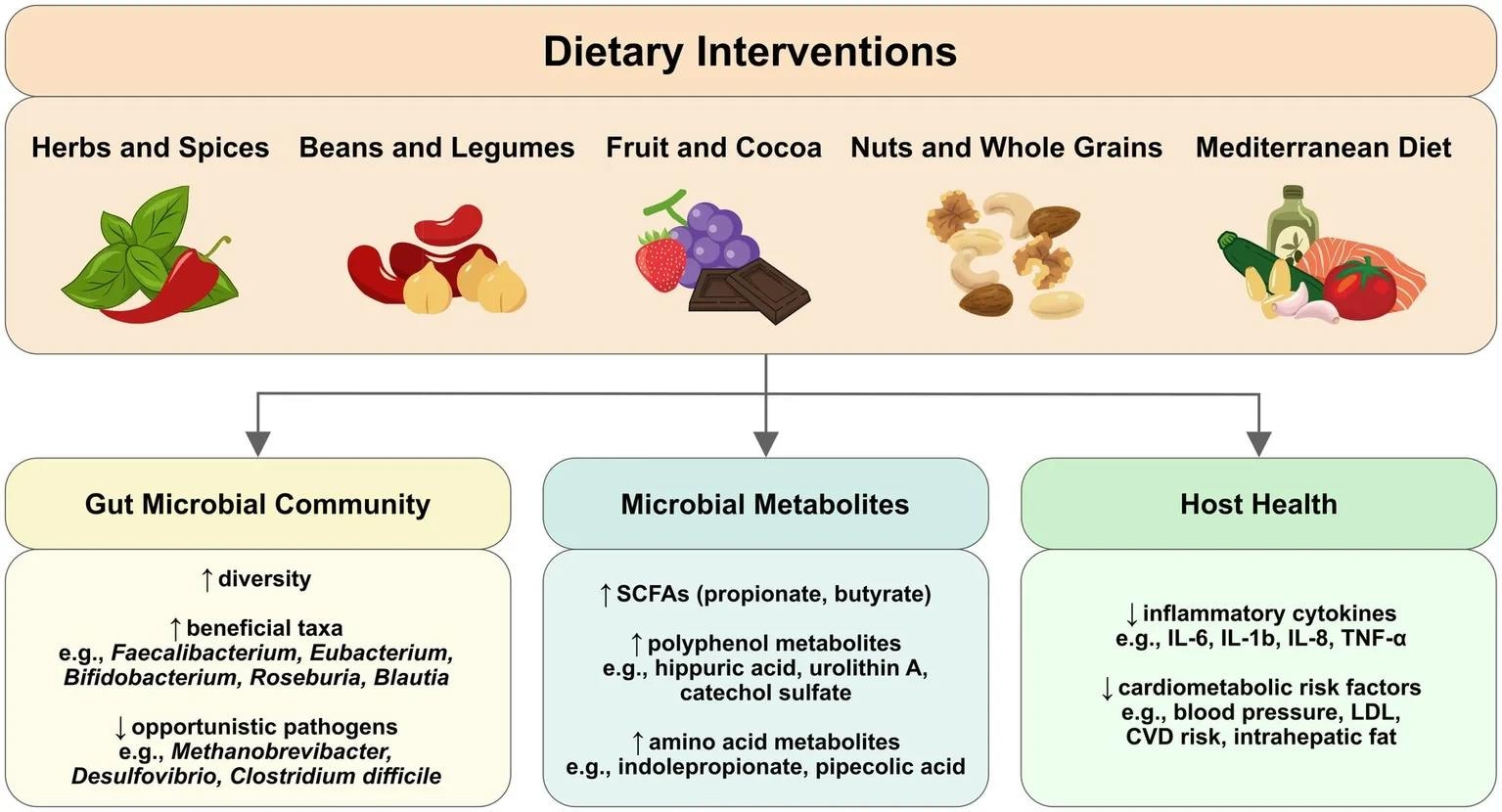
Dietary interventions can modulate gut microbial composition and metabolites that influence host health outcomes. Gut microbiome-targeting interventions can range from simple food additions to more complex dietary patterns, influencing gut microbial composition, diversity, metabolite production, and resulting health benefits. Arrows show the progression from dietary intake through microbial changes to host health outcomes. ↑ indicates increase; ↓ indicates decrease.3
The breakdown of prebiotic fibers like inulin, fructo-oligosaccharides (FOS), galacto-oligosaccharides (GOS), β-glucans, and resistant starches produces SCFAs like acetate, propionate, and butyrate, which affect immunity, appetite, glucose regulation, and epithelial barrier function by acting on G-protein–coupled receptors 41 (GPR41) and GPR43. Fiber-rich diets increase the abundance of Bifidobacterium, Ruminococcus, and Lactobacillus. In contrast, low-carbohydrate diets are associated with low levels of Roseburia and Eubacterium rectale, both of which are essential sources of SCFAs.2,4
Regular intake of yogurt, kefir, kimchi, and other fermented food products enhances microbial diversity and may reduce inflammatory markers in some populations.4 Conversely, diets that are high in fats and sugar reduce microbial diversity, disrupt mucosal integrity, and increase gut permeability through endotoxin-driven inflammation.1,3
Microbial metabolites act as biochemical messengers that transmit information between the immune system, brain, and skin. SCFAs, such as propionate, produced by multiple bacterial genera, including Akkermansia and Bacteroides, modulate inflammation by inhibiting nuclear factor kappa B (NF-κB) activity and reducing cytokine production, including interleukin-6 (IL-6) and interferon gamma (IFN-γ). Butyrate, generated by Faecalibacterium and Roseburia, acts as an energy source for colonocytes, strengthens tight junctions, and promotes regulatory T-cell development, all of which are essential for maintaining immune balance.3
Inflammation redirects tryptophan toward the kynurenine pathway, which produces neurotoxic metabolites like quinolinic acid. Microbial processing of tryptophan influences serotonin synthesis and activates the aryl hydrocarbon receptor (AhR), thus providing one mechanism by which microbial dysfunction may contribute to alterations in mood, immune tone, and skin barrier stability.5
Gordonibacter and Enterocloster convert polyphenol compounds like ellagitannins from berries and nuts into urolithins, particularly urolithin A. Urolithin A enhances mitophagy, which removes damaged mitochondria to improve muscle strength and endurance, as well as has been associated with reduced age-related inflammation.3
Effects on the brain
Gut dysbiosis leads to a leaky gut, allowing lipopolysaccharides (LPS) to activate toll-like receptor-4 (TLR4) and increase cytokine production, such as tumor necrosis factor-alpha (TNF-α). This inflammatory signaling alters neurotransmission and reduces brain-derived neurotrophic factor (BDNF), a key molecule for mood regulation.5,6
Together, these immune-mediated pathways provide a mechanistic link between intestinal dysbiosis, systemic inflammation, and altered brain function.
Psychobiotics, including Lactobacillus acidophilus, L. rhamnosus, and Bifidobacterium longum, reduce stress reactivity, with multispecies probiotic formulations showing modest improvements in depressive symptoms. Potential mechanisms include vagus nerve signaling and enhanced tryptophan availability for serotonin synthesis.5,6
Dysbiosis-driven LPS–TLR4 signaling, nucleotide-binding domain, leucine-rich-containing family, pyrin domain-containing-3 (NLRP3) inflammasome activation, and increases in IL-1β and IL-18 contribute to neuroinflammation, which has the potential to impact microglial activity and neuronal function.
Chronic low-grade inflammation accelerates cognitive decline by impairing synaptic function and lowering BDNF levels. Restoring microbial balance through Bifidobacterium infantis supplementation has been shown to normalize the kynurenine-to-tryptophan ratio, whereas some strains of L. rhamnosus have been associated with changes in neurotransmitter-related signaling in preclinical and limited human studies. Early human trials with L. helveticus have reported minor improvements in memory and attention; however, larger, longer-duration, and more rigorously controlled trials are still needed.5,6
Effects on the skin
Gut microbial dysregulation disrupts the intestinal barrier, thereby allowing bacterial metabolites and inflammatory mediators to enter systemic circulation. These circulating signals may exacerbate inflammation in atopic dermatitis through effects on T-helper type 2 cells, acne through insulin-like growth factor-1 signaling, and psoriasis through IL-17–driven immune responses.
Reduced Bifidobacterium and Lactobacillus and elevated Clostridioides difficile, Escherichia coli, and Staphylococcus aureus have frequently been observed in atopic dermatitis. Likewise, imbalances in Actinobacteria, Proteobacteria, and Bacteroidetes have been associated with acne and psoriatic disease.1,7,8
Reduced intestinal SCFA production, particularly butyrate, weakens tight junctions, inhibits ceramide synthesis, and increases transepidermal water loss. Probiotics like Lactobacillus plantarum HY7714 and Bifidobacterium breve B-3 may support skin elasticity, hydration, and barrier integrity by modulating genes that control tight junction proteins such as occludin and zonula occludens-1 (ZO-1).1,7,8
Upregulated matrix metalloproteinases (MMPs) are characteristic of the senescence-associated secretory phenotype (SASP) and degrade both collagen and elastin. Emerging studies suggest that certain probiotics may attenuate ultraviolet light (UV)-induced oxidative stress, inflammatory signaling, and MMP expression.8
Dietary patterns that support this axis
The Mediterranean diet, which emphasizes the consumption of fruits, vegetables, legumes, whole grains, nuts, olive oil, and fish, provides monounsaturated (MUFA) and polyunsaturated fats (PUFA), polyphenols, and prebiotic fibers that support gut, brain, and skin health. Results from the NU-AGE and CORDIOPREV trials confirm that this dietary pattern improves microbial diversity, enhances SCFA production, reduces inflammation, and strengthens gut barrier function.3,4
Plant-based diets high in fiber promote SCFA-producing microorganisms and beneficial metabolites, such as indolepropionate, pipecolic acid, and urolithin A, which regulate intestinal permeability and prevent inflammation. Interventions with legumes and whole grains increase the abundance of Eubacterium and Bifidobacterium, lower low-density lipoprotein (LDL) cholesterol, and improve glycemic control.3,4
Image Credit: Elena Eryomenko / Shutterstock.com
Clinical and future applications
Personalized microbiome-based interventions can include probiotics and postbiotics developed based on an individual’s microbial profile and genetics, with the potential to provide targeted effects while minimizing adverse responses. Certain bacterial strains and their metabolites are currently being studied for their impact on intestinal barrier integrity, the kynurenine pathway, as well as systemic and neuroinflammation.5 Multi-omics approaches have also been used to identify microbial signatures and metabolites involved in cognition, mood, and skin physiology, which can further support precision nutrition and therapeutic development.5
Machine learning has also been used to create specific meal recommendations aimed at improving microbial diversity, enriching SCFA-producing taxa such as Faecalibacterium prausnitzii, Roseburia hominis, and Flavonifractor plautii, and reducing epithelial cell shedding.3
Inflammatory biomarker tracking
Systemic markers like CRP, IL-6, TNF-α, and circulating LPS can be used to monitor inflammation associated with dysbiosis and barrier dysfunction. Gut-specific indicators, including fecal calprotectin and zonulin, provide additional insight into intestinal inflammation and permeability.
Taken together, integrating blood and stool biomarker testing with microbiome sequencing has the potential to identify dysbiosis patterns, monitor patient responses to interventions, and personalize diet, probiotic, and lifestyle strategies.9,10
References
- Kiu, L. Y. (2025). The Gut-brain-skin Axis and Acne Vulgaris: Current Understanding and the Management Implications. Clinical Dermatology Review 9(3); 213-219. DOI: 10.4103/cdr.cdr_102_22. https://journals.lww.com/cddr/fulltext/2025/07000/the_gut_brain_skin_axis_and_acne_vulgaris__current.1.aspx.
- Cheng, B., Feng, H., Li, C., et al. (2025). The mutual effect of dietary fiber and polyphenol on gut microbiota: Implications for the metabolic and microbial modulation and associated health benefits. Carbohydrate Polymers, 358. DOI: 10.1016/j.carbpol.2025.123541. https://www.sciencedirect.com/science/article/abs/pii/S0144861725003224.
- Meiners, F., Ortega-Matienzo, A., Fuellen, G., & Barrantes, I. (2025). Gut microbiome-mediated health effects of fiber and polyphenol-rich dietary interventions. Frontiers in Nutrition 12. DOI: 10.3389/fnut.2025.1647740. https://www.frontiersin.org/journals/nutrition/articles/10.3389/fnut.2025.1647740/full
- Piccioni, A., Covino, M., Candelli, M., et al. (2023). How Do Diet Patterns, Single Foods, Prebiotics and Probiotics Impact Gut Microbiota? Microbiology Research 14(1); 390-408. DOI: 10.3390/microbiolres14010030. https://www.mdpi.com/2036-7481/14/1/30
- Kearns, R. (2024). Gut–Brain Axis and Neuroinflammation: The Role of Gut Permeability and the Kynurenine Pathway in Neurological Disorders. Cellular and Molecular Neurobiology 44(64). DOI: 10.1007/s10571-024-01496-z. https://link.springer.com/article/10.1007/s10571-024-01496-z
- Menezes, A. A., & Shah, Z. A. (2024). A Review of the Consequences of Gut Microbiota in Neurodegenerative Disorders and Aging. Brain Sciences 14(12); 1224. DOI: 10.3390/brainsci14121224. https://www.mdpi.com/2076-3425/14/12/1224.
- Sadowsky, R. L., Sulejmani, P., & Lio, P. A. (2023). Atopic Dermatitis: Beyond the Skin and Into the Gut. Journal of Clinical Medicine 12(17). DOI: 10.3390/jcm12175534. https://www.mdpi.com/2077-0383/12/17/5534
- Ratanapokasatit, Y., Laisuan, W., Rattananukrom, T., et al. (2022). How Microbiomes Affect Skin Aging: The Updated Evidence and Current Perspectives. Life 12(7); 936. DOI: 10.3390/life12070936. https://www.mdpi.com/2075-1729/12/7/936.
- Lin, L., George, J., & Liu, G. (2025). Biomarker Quantification of Gut Dysbiosis-Derived Inflammation: A Review. Journal of Inflammation Research 18. DOI: 10.2147/JIR.S539155. https://www.dovepress.com/biomarker-quantification-of-gut-dysbiosis-derived-inflammation-a-revie-peer-reviewed-fulltext-article-JIR.
- Sarb, O., Sarb, A., Iacobescu, M., et al. (2023). From Gut to Brain: Uncovering Potential Serum Biomarkers Connecting Inflammatory Bowel Diseases to Neurodegenerative Diseases. International Journal of Molecular Sciences 25(11). DOI: 10.3390/ijms25115676. https://www.mdpi.com/1422-0067/25/11/5676
Further Reading
Last Updated: Jan 19, 2026